Sustainability
  • Progress

    By tracking key metrics and milestones, we demonstrate our commitment to building a more sustainable future worldwide.

    Explore

    • Progress
    • Climate Solutions
      • Climate Solutions
      • Carbon-Free Energy
      • Transportation
      • Buildings
    • Waste & Circularity
      • Waste & Circularity
      • Packaging Innovation
      • Recycle Your Amazon Packaging
    • Natural Resources
      • Natural Resources
      • Water Stewardship
      • Biodiversity
      • Nature in Communities
    • Human Rights
      • Human Rights
      • Human Rights Principles
      • Supply Chain
    • Products & Services
      • Products & Services
      • AWS Cloud
      • Amazon Devices
      • Amazon Devices Climate Tech Accelerator
    • People

      • Customers
      • Employees
      • Communities
    • Climate Solutions
      • Climate Solutions
      • Carbon-Free Energy
      • Transportation
      • Buildings
    • Waste & Circularity
      • Waste & Circularity
      • Packaging Innovation
      • Recycle Your Amazon Packaging
    • Natural Resources
      • Natural Resources
      • Water Stewardship
      • Biodiversity
      • Nature in Communities
    • Human Rights
      • Human Rights
      • Human Rights Principles
      • Supply Chain
    • Products & Services
      • Products & Services
      • AWS Cloud
      • Amazon Devices
      • Amazon Devices Climate Tech Accelerator
    • People

      • Customers
      • Employees
      • Communities
    • For Businesses

      • Sustainability Exchange , opens in a new tab
      • The Climate Pledge , opens in a new tab
      • Sustainability Solutions Hub , opens in a new tab
      • AWS Sustainability , opens in a new tab
      • Sustainability Accelerator Climate Tech
    • For Customers
      • For Customers
      • Recycle Your Amazon Packaging
      • Climate Pledge Friendly , opens in a new tab
      • Pre-Owned Products , opens in a new tab
      • Repair Electronics , opens in a new tab
      • Recycle & Trade-In Electronics , opens in a new tab
    • Sustainability Reports
      • Sustainability Reports
      • 2025 Sustainability Report New
      • 2024 Sustainability Report
      • 2023 Sustainability Report , opens in a new tab
      • 2022 Sustainability Report , opens in a new tab
      • All reports
    • Popular Downloads

      • Carbon Methodology
      • Renewable Energy Methodology
      • Supply Chain Standards
      • All Downloads
  • 2025 Sustainability Report New

    Modern industrial warehouse with two-tone facade, blue canopy over loading docks, delivery vehicles, trees, and reflecting pond in foreground.

    Explore

    • Sustainability Reports

      • 2025 Sustainability Report New
      • 2024 Sustainability Report
      • 2023 Sustainability Report , opens in a new tab
      • 2022 Sustainability Report , opens in a new tab
      • All Reports
    • Sustainability Reports

      • 2025 Sustainability Report New
      • 2024 Sustainability Report
      • 2023 Sustainability Report , opens in a new tab
      • 2022 Sustainability Report , opens in a new tab
      • All Reports
  • Global Action
  • Stories
Sustainability
Back to all stories

How AI is transforming Amazon’s disaster relief efforts around the world

  • Jul 22, 2026
  • 5 min
  • 🌎 Global

How AI is transforming Amazon’s disaster relief efforts around the world

Person smiling

Cecilia Brezmes Alonso

Senior Lead, Sustainability, Human Rights & Social Impact, Amazon

Share this article

From spreadsheets to AI, here’s how Amazon's Disaster Relief team is getting help where it's needed, faster. 

Key takeaways:

  • Since 2017, Amazon's Disaster Relief team has donated more than 30 million supplies across 200+ disasters worldwide, evolving from spreadsheets and phone calls to AI-powered tools that can speed up response times and improve decision-making.
  • AI agents, drones, and image classification are transforming disaster response. During Hurricane Helene, AI-stitched drone imagery gave first responders a picture of devastation on the ground, enabling expansive search-and-rescue missions and fast delivery of critical supplies to hard-to-reach communities.
  • AI enhances but doesn't replace human judgment in disaster relief efforts. While agentic AI synthesizes real-time data to identify community needs and reduce redundancies, the Amazon Disaster Relief team relies on human expertise, cultural understanding, and creativity to serve affected communities.

When Abe Diaz first volunteered for Amazon’s Disaster Relief team in 2017, he helped coordinate our response to Hurricane Maria in Puerto Rico using the technology available to him: spreadsheets, emails, and phone calls.

“As we were loading the plane with pallets, I realized the people who helped pack them in Florida—where many of our employees are Puerto Rican—had written messages like ‘You got this’ and ‘We're with you,’” Diaz said. “I started crying like a baby. As soon as there was an opening on the team, I decided to go for it."

Nearly a decade later, our Disaster Relief team has donated and delivered more than 30 million relief supplies and technology to help communities recover in the aftermath of over 200 disasters around the world. The team tracks emerging threats as they develop and donates tarps, blankets, diapers, medical devices, and more from our Disaster Relief Hubs, which are strategically located near disaster-prone areas across the U.S., Europe, Asia, and Australia. The team is also scaling our rapid response technology systems, providing hundreds of reusable systems at no cost to first responders and nonprofits every year. Each system is designed to overcome common challenges in the immediate aftermath of a disaster—for example, satellite connectivity so a doctor can access Wi-Fi or solar batteries so a shelter manager can brew a pot of coffee. 

Abe Diaz now leads Amazon’s Disaster Relief team, and he and his colleagues have more tools at their disposal. Among them is artificial intelligence, helping the team make faster decisions, train new volunteers, and deliver the right supplies more quickly. Many of these capabilities build on the same logistics technology, operational expertise, and AI systems that help Amazon deliver millions of packages to customers every day, now adapted to help communities when they need them most. What AI isn't replacing is what sits at the center of every disaster response: human judgment, empathy, and local understanding.

This conversation has been edited for length and clarity
.

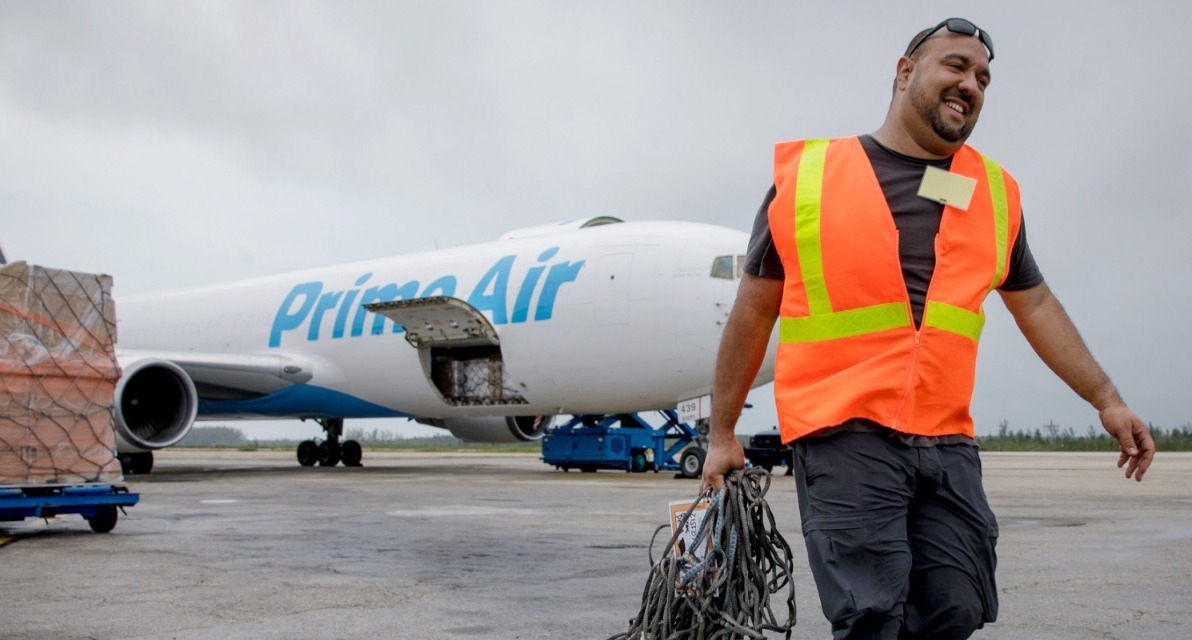
Abe Diaz, head of Amazon's Disaster Relief team, unloads emergency supplies from a Prime Air plane.

Abe Diaz, head of Amazon's Disaster Relief team, unloads emergency supplies from a Prime Air plane.

Amazon Sustainability: How has AI changed Amazon's disaster relief efforts from 2017 to today?

Abe Diaz: In 2017, I was calculating weight, volume, and the dimensions of everything we were putting on the plane in Excel. We were really at the forefront of what could be done, but we had no tools. Fast forward to 2026, and we can leverage AI and quickly double-check the items and volumes we need. During Hurricane Helene in 2025, we had people working with first responders, flying drones and capturing images across 2,700 acres. We got thousands of images and videos, and then composed them into a much larger picture—you stitch them together to make one cohesive map. AI helped us see what was actually happening on the ground at a speed and detail that’s simply not possible with the human eye alone. It led to additional search-and-rescue missions because first responders could cover more ground, faster, and didn’t have to risk dangerous searches on foot. We were able to work with the National Guard and airlift and drop in baby formula in places that were difficult to reach. The same approach continues to shape our responses today. Whether responding to wildfires, hurricanes, or most recently the earthquakes in Venezuela, our goal is the same: understand what communities need as quickly as possible so we can help get the right supplies to the right place at the right time. In Venezuela, AI is also helping with practical tasks like translating packing lists for international shipments.

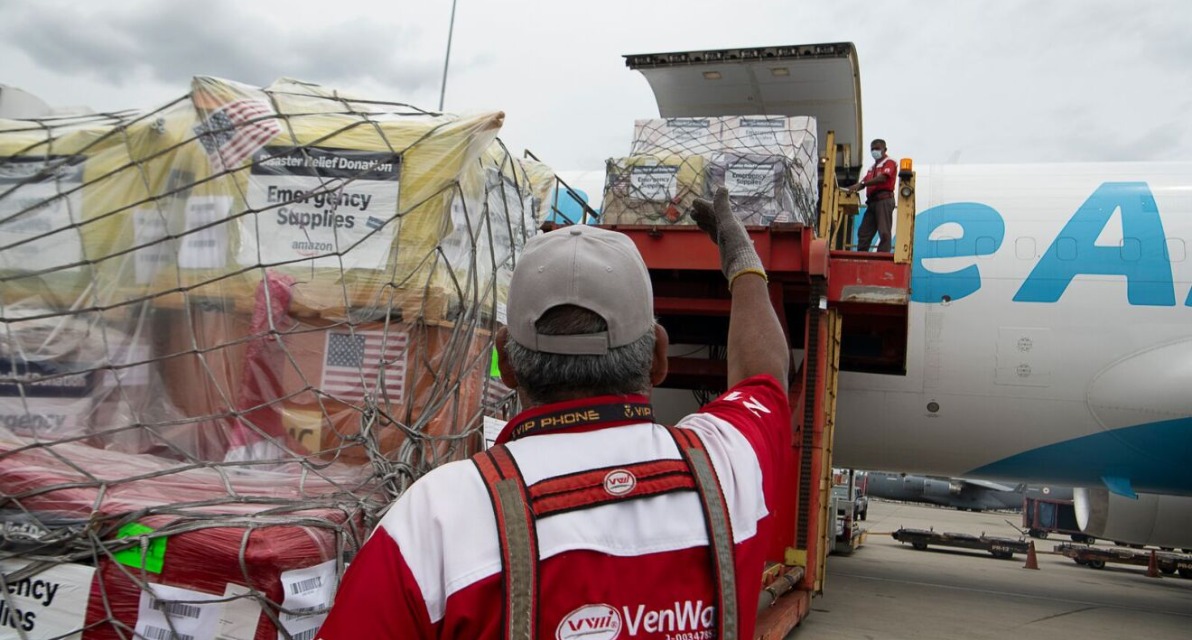
Amazon employees unload emergency supplies for earthquake relief in Caracas, Venezuela, on July 3, 2026.

Amazon employees unload emergency supplies for earthquake relief in Caracas, Venezuela, on July 3, 2026.

Amazon Sustainability: What does it feel like when you're using these tools and seeing their effects? Was there a moment when you thought, “This changes everything?”

Abe Diaz: It's an understanding that we can do a lot more, faster. That's the “Oh, wow”—imagine if we could cover more locations, more miles, and serve our communities faster. That's what AI does for us. We can classify images, we can look at damage assessments, we can say what neighborhoods have minor or major damage or are completely devastated, and provide a lot of information to the people at the center of the response that in the past would have taken much longer. That's my hope: that we're able to provide a faster speed not just in our urgent operations, but for any community that has to recover and rebuild from a devastating disaster. 

Amazon Sustainability: What AI is your team using that’s serving the community in a valuable way, and how does it work? 

Abe Diaz: There is so much information in disaster relief that is crunched on a daily basis to understand what's happening with the weather, who’s in which location, how many people are in shelters today, the situation with the roads—layer upon layer of data. But now we have AI agents that can do work for us when we’re not awake or can alert us when things are happening. 

That’s exactly what the American Red Cross is creating with its Clara AI agent, which is being built now with an Amazon Web Services (AWS) grant. These agents can gather new data, synthesize it, and create a common operating picture of what is happening on the ground so that we can ask good questions. In the future, we could say, “Over the last 12 hours, are there any spikes in needs within the community that we should learn more about?” Agents can then say, “Yeah, we're noticing on social media a lot of people in this location saying they're hungry, and we don't see any feeding organizations who self-reported being there.” That is a signal that in the past could take days to surface. 

AI is also helping reduce redundancies. The worst thing you can do is show up in a place wanting to feed the people there only to learn somebody else already did that two hours ago. We only send what has been requested, in the quantities that have been requested, and we make sure that communities get it exactly when they need it. We commit to quick delivery timelines because it reduces overall recovery times for communities and because we’re Amazon—that’s what we’re known for. As we leverage agentic behavior to constantly process and synthesize, it can surface gaps in needs we hadn't seen yet, helping us serve more communities, faster. 

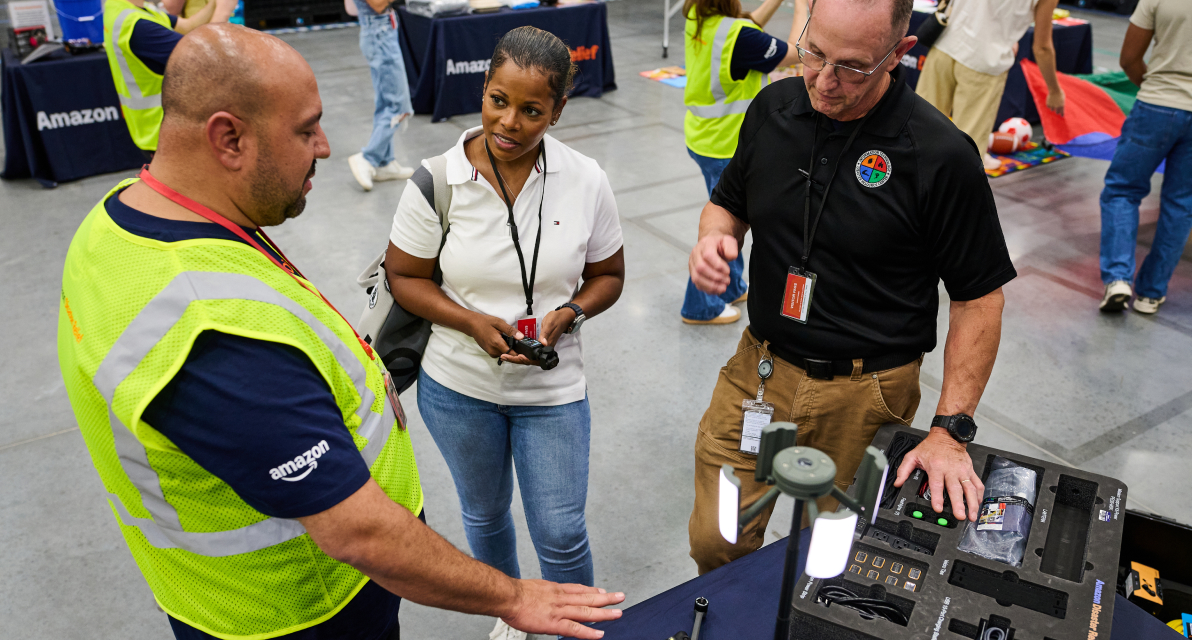
Abe Diaz and his team showcase the latest tech and tools at the Amazon Disaster Relief Tech Hub near Nashville, Tennessee.

Abe Diaz and his team showcase the latest tech and tools at the Amazon Disaster Relief Tech Hub near Nashville, Tennessee.

Amazon Sustainability: Some people have a perception that AI replaces human judgment. Are there examples in your work of cases in which AI helped make your team or relief efforts more human?

Abe Diaz: I don't think AI is ever going to replace human judgment. It's really good at understanding everything that happened before now, but when it comes to creativity, when it comes to understanding community needs and the daily challenges it’s facing, it's just very different—it's not really good at that. It might be a past explainer, but it's definitely not a fortune teller. We're serving people across different languages and cultures; we know that if you don't have somebody on your team, for example, who understands that culture, your responses are not going to be able to serve that community the way that they want to be served. You need that human understanding.

What AI does exceptionally well is it helps us understand what's happening. It can synthesize thousands of signals, identify patterns, and surface information we might otherwise miss. But people still decide what matters most. For us, AI doesn't replace the human element. It strengthens it. By helping our teams understand situations faster and more completely, it gives people better information to make better decisions. That means relief can reach communities sooner, volunteers spend less time sorting through data and more time helping people, and our partners can work together more effectively. That's where technology has the potential to make a real difference. AI isn't replacing humanity. It's helping us put it into action faster.

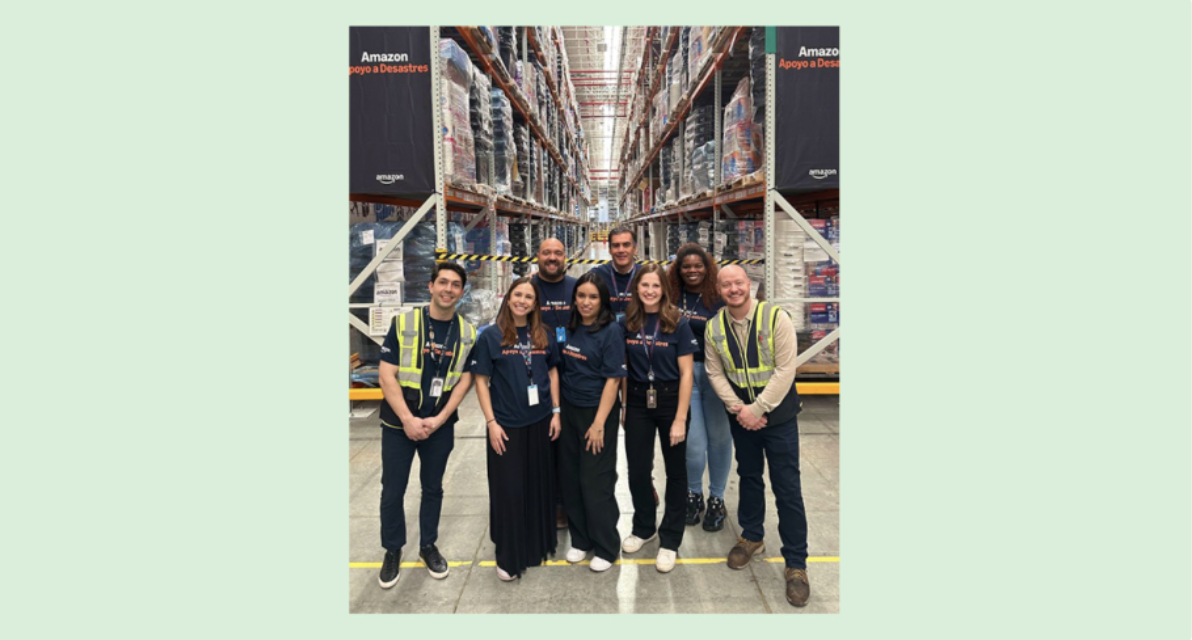
Amazon's Disaster Relief team at the opening of the company's first Disaster Relief Hub in Mexico.

Amazon's Disaster Relief team at the opening of the company's first Disaster Relief Hub in Mexico.

Amazon Sustainability: Looking ahead, what gives you the most hope?

Abe Diaz:
Every disaster creates an enormous amount of uncertainty. People are trying to understand what's happened, what communities need, and where to go next. What excites me about AI is its ability to shorten the time between information and action. The faster we can understand what's happening, the faster we can make good decisions. And in disaster response, every minute matters.


Learn more about
Amazon’s disaster relief efforts.

Sign up for our monthly newsletter to get Amazon sustainability updates sent directly to your inbox.

Related stories

  • A person kneeling next to a dog for a photo.

    Carbon-free energy

    Jun 12, 2026 3 min 🌎 Global

    Inside Amazon's approach to data center sustainability: a conversation with Brandon Oyer

  • Carbon-free energy

    Jun 12, 2026 3 min 🌎 Global

    Optimize, generate, transform: Amazon's path toward a carbon-free energy future

  • A person smiling.

    AI

    Fortune

    Sep 22, 2025 5 min 🇺🇸 United States

    Amazon sustainability chief and top scientist: AI could end up being climate’s most powerful tool , opens in a new tab

1 of 3

Article author image

Transcript

  • Human Rights & Environmental Complaints Procedure
  • Disclaimer
  • Sitemap
  • Newsletter Sign-Up , opens in a new tab
  • The Climate Pledge , opens in a new tab
  • About Amazon , opens in a new tab
  • Amazon.com , opens in a new tab
  • Investor Relations , opens in a new tab
  • Press Center , opens in a new tab
  • Privacy Notice , opens in a new tab
  • Conditions of Use , opens in a new tab
  • Sustainability News , opens in a new tab
  • Sustainability Jobs , opens in a new tab
  • Follow on LinkedIn , opens in a new tab

© 1996-2026 Amazon.com, Inc. or its affiliates

Sustainability

© 1996-2026 Amazon.com, Inc. or its affiliates