Sustainability
  • Progress

    By tracking key metrics and milestones, we demonstrate our commitment to building a more sustainable future worldwide.

    Explore

    • Progress
    • Climate Solutions
      • Climate Solutions
      • Carbon-Free Energy
      • Transportation
      • Buildings
    • Waste & Circularity
      • Waste & Circularity
      • Packaging Innovation
      • Recycle Your Amazon Packaging
    • Natural Resources
      • Natural Resources
      • Water Stewardship
      • Biodiversity
      • Nature in Communities
    • Human Rights
      • Human Rights
      • Human Rights Principles
      • Supply Chain
    • Products & Services
      • Products & Services
      • AWS Cloud
      • Amazon Devices
      • Amazon Devices Climate Tech Accelerator
    • People

      • Customers
      • Employees
      • Communities
    • Climate Solutions
      • Climate Solutions
      • Carbon-Free Energy
      • Transportation
      • Buildings
    • Waste & Circularity
      • Waste & Circularity
      • Packaging Innovation
      • Recycle Your Amazon Packaging
    • Natural Resources
      • Natural Resources
      • Water Stewardship
      • Biodiversity
      • Nature in Communities
    • Human Rights
      • Human Rights
      • Human Rights Principles
      • Supply Chain
    • Products & Services
      • Products & Services
      • AWS Cloud
      • Amazon Devices
      • Amazon Devices Climate Tech Accelerator
    • People

      • Customers
      • Employees
      • Communities
    • For Businesses

      • Sustainability Exchange , opens in a new tab
      • The Climate Pledge , opens in a new tab
      • Sustainability Solutions Hub , opens in a new tab
      • AWS Sustainability , opens in a new tab
      • Sustainability Accelerator Climate Tech New
    • For Customers
      • For Customers
      • Recycle Your Amazon Packaging
      • Climate Pledge Friendly , opens in a new tab
      • Pre-Owned Products , opens in a new tab
      • Repair Electronics , opens in a new tab
      • Recycle & Trade-In Electronics , opens in a new tab
    • Sustainability Reports
      • Sustainability Reports
      • 2024 Sustainability Report
      • 2023 Sustainability Report , opens in a new tab
      • 2022 Sustainability Report , opens in a new tab
      • All reports
    • Popular Downloads

      • Carbon Methodology
      • Renewable Energy Methodology
      • Supply Chain Standards
      • All Downloads
  • 2024 Sustainability Report

    Explore

    • Sustainability Reports

      • 2024 Sustainability Report
      • 2023 Sustainability Report , opens in a new tab
      • 2022 Sustainability Report , opens in a new tab
      • All Reports
    • Sustainability Reports

      • 2024 Sustainability Report
      • 2023 Sustainability Report , opens in a new tab
      • 2022 Sustainability Report , opens in a new tab
      • All Reports
  • Global Action New
  • Stories New
Sustainability
Back to all stories

Optimize, generate, transform: Amazon's path toward a carbon-free energy future

  • Jun 12, 2026
  • 3 min
  • 🌎 Global

Carbon-free energy

A power line seen through trees with blue skies.

Optimize, generate, transform: Amazon's path toward a carbon-free energy future

A person smiling

Chris Roe

Director of Worldwide Carbon, Amazon

Share this article

How we’re using less, doing more, and investing where it counts—at scale. 

Amazon’s operations span nearly every inch of the globe (and sometimes space). Offices, warehouses, data centers, and delivery systems across dozens of countries require a significant amount of energy to allow us to deliver for customers. We don't take that lightly, which is why we're applying the same inventiveness that drives our business to work toward operating among the most efficient infrastructure in the world. These efforts are in service of The Climate Pledge, our goal to reach net-zero carbon emissions by 2040.  


We believe transitioning to carbon-free energy is one of the most consequential challenges of our time—and one of the greatest opportunities to innovate and build something better. Our approach starts with a simple conviction: no single technology, region, or solution will get us there. So we invest across the spectrum—wind, solar, hydroelectric, geothermal, nuclear, and battery storage—and direct investment where it can have the most impact. We don't have a perfect roadmap. But we believe that acting boldly, while being honest about what we're still learning, is better than waiting on the sidelines.  
 

Optimize. Use less. Do more.


The best way to reduce emissions is to use less energy in the first place. That’s why optimization comes first—before we add a single megawatt-hour of new electricity generation, we work to make every megawatt-hour we use go further. 

An Amazon Web Services (AWS) Graviton4 chip.
An aerial view of Amazon data center construction in Warren County, Mississippi.
Amazon’s electric fleet in Bengaluru, India, helps make last-mile customer deliveries with zero tailpipe emissions.
Displaying 1 of 3

1 3

An Amazon Web Services (AWS) Graviton4 chip.

An aerial view of Amazon data center construction in Warren County, Mississippi.

Amazon’s electric fleet in Bengaluru, India, helps make last-mile customer deliveries with zero tailpipe emissions.

Displaying 1 of 3

1 3

We’re constantly re-evaluating how our data centers operate and determining ways to help them run more efficiently. One way we measure this is Power Usage Effectiveness (PUE). In 2025, Amazon data centers achieved a PUE of 1.14, better than the public cloud industry average and on-premises enterprise infrastructure. AWS custom Graviton chips use up to 60% less energy than comparable instances for the same performance, and our newest data center design strives to move just enough air through our servers to keep them from overheating, while using the lowest amount of energy and water to do that. We aim to build with lower-carbon concrete and steel whenever possible, run AI-powered monitoring tools designed to catch waste before it accumulates, and we’re starting to transition backup generators to fuels like hydro-treated vegetable oil, which can reduce lifecycle emissions by up to 90% compared to fossil diesel. 


Our delivery fleet is undergoing a similar transformation. We've deployed more than 52,000 electric delivery vans across the U.S., Europe, and India, putting us over halfway toward our goal of 100,000 electric vans on the road by 2030. In 2025 alone, those vehicles delivered more than 2.3 billion packages globally. It's one of the easiest ways our customers can see our progress in action—and a reminder that decarbonization isn't just about the grid. It's about every mile, route, and package that reaches your door. 
 

We know that optimization doesn't happen in a straight line. As demand for AI and cloud computing grows, so does the demand for energy. We don't shy away from that tension—it's why optimizing for efficiency isn't a one-time initiative. It's a discipline we have to keep sharpening, year after year. 
 

Generate. Invest where it matters most. 
 

Using less energy matters, but it’s not enough on its own. Optimization is only one part of the picture—we also need to invest in carbon-free energy at scale. 

Using machine learning, Amazon’s Baldy Mesa battery storage project in Adelanto, California, helps stabilize the grid by delivering stored solar energy when it is needed the most.
In Madison Fields, Ohio, solar is integrated with forage crop production.
A rendering of the first small modular nuclear reactor facilities in the United States.
Displaying 1 of 3

1 3

Using machine learning, Amazon’s Baldy Mesa battery storage project in Adelanto, California, helps stabilize the grid by delivering stored solar energy when it is needed the most.

In Madison Fields, Ohio, solar is integrated with forage crop production.

A rendering of the first small modular nuclear reactor facilities in the United States.

Displaying 1 of 3

1 3

Since 2020, Amazon has been one of the world's largest corporate purchasers of carbon-free energy, according to BloombergNEF. We operate more than 700 carbon-free energy projects across 30 countries, generating 42 gigawatts of capacity—enough to power over 12 million U.S. homes.  
 

Those numbers are meaningful, especially since we use an emissions-first approach: Rather than matching energy consumption globally, we direct investments to the grids that need them most—ones primarily powered by fossil fuels, where a single renewable project can avoid dozens of times more emissions than the same project built in an already-clean grid. In India alone, our renewable projects have the potential to avoid 55 times more carbon annually than the equivalent capacity in Sweden. 
 

Methodologies are still maturing across the industry, but we're pushing ourselves to measure more than just emissions. We want to understand the full range of benefits that come from our carbon-free energy investments, so we're considering the potential health, biodiversity, and socioeconomic benefits of Amazon's carbon-free energy portfolio. It's part of considering more than megawatts as we track progress and capture the real-world difference these investments can make for the communities and ecosystems around them. 
 

The next frontier goes beyond renewables. We're growing Amazon's carbon-free energy portfolio with nuclear power. Through landmark investments in small modular reactor (SMR) technology—with Energy Northwest in Washington State and through our $500 million equity stake in X-energy—we are helping bring the next generation of nuclear energy to commercial scale, aiming for more than five gigawatts of new nuclear capacity by 2039. These promising technologies haven’t been proven at a commercial scale yet, but that's why we're investing now; waiting for certainty can mean waiting too long. 
 

Transform. Push the whole system forward. 
 

We are investing in infrastructure that makes carbon-free energy reliable and accessible for everyone because a more efficient grid doesn't just benefit Amazon—it can benefit every community, home, hospital, school, and business connected to it. 

Amazon’s first South African solar plant.
An Amazon wind energy project in Poland.
In Mississippi, Amazon is investing in new energy infrastructure and upgrades to strengthen overall grid reliability for all Entergy customers.
Displaying 1 of 3

1 3

Amazon’s first South African solar plant.

An Amazon wind energy project in Poland.

In Mississippi, Amazon is investing in new energy infrastructure and upgrades to strengthen overall grid reliability for all Entergy customers.

Displaying 1 of 3

1 3

We advocate for the transmission upgrades, interconnection reforms, and policies that allow carbon-free energy to connect quickly and flow freely. Interconnection timelines mean projects that could be operational within 18 months can take up to five years. These are systematic challenges that no single company can solve, and we are actively working to address them. We collaborate with utilities, grid operators, and policymakers across the communities where we operate—all while paying the full cost of the energy and infrastructure our operations require, so communities don’t bear that burden.  
 

We have also helped pave the way in new regions. In South Africa, for example, we negotiated the regulatory structures that enabled the country's first corporate renewable energy agreement, and we made those structures available to any company interested in replicating such an agreement. In Poland, our investments have directly supported the government's goal of increasing renewable energy on the grid.  
 

The economic impact is real. Amazon's carbon-free energy projects have stimulated more than $12 billion in estimated economic investment globally since 2014, supporting tens of thousands of jobs in communities across Virginia, Ohio, Oregon, and beyond. We co-founded the Emissions First Partnership with General Motors, Intel, Meta, and Rivian to advance carbon accounting standards that measure real-world impact. And over 650 companies have joined us in working toward the goal of net-zero carbon emissions by 2040 through The Climate Pledge. 
 

Ultimately, our approach is grounded in accountability to our climate goals, to the communities where we operate, and to an honest accounting of our progress. We measure that progress by impact—on emissions, on communities, and on the shared energy future we are helping to build.  


Learn more about Amazon's carbon-free energy progress. 
 

Sign up for our monthly newsletter to get Amazon sustainability updates sent directly to your inbox. 

Related stories

  • A person kneeling next to a dog for a photo.

    Carbon-free energy

    Jun 12, 2026 3 min 🌎 Global

    Inside Amazon's approach to data center sustainability: a conversation with Brandon Oyer

  • Carbon-free energy

    Jun 1, 2026 4 min 🌎 Global

    How Amazon is helping customers reduce their cloud carbon footprint

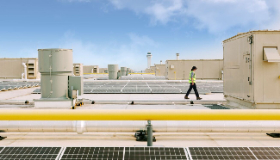
  • A person walks on the roof of a building with solar panels.

    Carbon-free energy

    Amazon News

    Apr 27, 2026 1 min 🌎 Global

    Amazon remains a global leader in corporate carbon-free energy purchasing , opens in a new tab

1 of 3

Article author image

Transcript

  • Human Rights & Environmental Complaints Procedure
  • Disclaimer
  • Sitemap
  • Newsletter Sign-Up , opens in a new tab
  • The Climate Pledge , opens in a new tab
  • About Amazon , opens in a new tab
  • Amazon.com , opens in a new tab
  • Investor Relations , opens in a new tab
  • Press Center , opens in a new tab
  • Privacy Notice , opens in a new tab
  • Conditions of Use , opens in a new tab
  • Sustainability News , opens in a new tab
  • Sustainability Jobs , opens in a new tab
  • Follow on LinkedIn , opens in a new tab

© 1996-2026 Amazon.com, Inc. or its affiliates

Sustainability

© 1996-2026 Amazon.com, Inc. or its affiliates