Sustainability
  • Progress

    By tracking key metrics and milestones, we demonstrate our commitment to building a more sustainable future worldwide.

    Explore

    • Progress
    • Climate Solutions
      • Climate Solutions
      • Carbon-Free Energy
      • Transportation
      • Buildings
    • Waste & Circularity
      • Waste & Circularity
      • Packaging Innovation
      • Recycle Your Amazon Packaging
    • Natural Resources
      • Natural Resources
      • Water Stewardship
      • Biodiversity
      • Nature in Communities
    • Human Rights
      • Human Rights
      • Human Rights Principles
      • Supply Chain
    • Products & Services
      • Products & Services
      • AWS Cloud
      • Amazon Devices
      • Amazon Devices Climate Tech Accelerator
    • People

      • Customers
      • Employees
      • Communities
    • Climate Solutions
      • Climate Solutions
      • Carbon-Free Energy
      • Transportation
      • Buildings
    • Waste & Circularity
      • Waste & Circularity
      • Packaging Innovation
      • Recycle Your Amazon Packaging
    • Natural Resources
      • Natural Resources
      • Water Stewardship
      • Biodiversity
      • Nature in Communities
    • Human Rights
      • Human Rights
      • Human Rights Principles
      • Supply Chain
    • Products & Services
      • Products & Services
      • AWS Cloud
      • Amazon Devices
      • Amazon Devices Climate Tech Accelerator
    • People

      • Customers
      • Employees
      • Communities
    • For Businesses

      • Sustainability Exchange , opens in a new tab
      • The Climate Pledge , opens in a new tab
      • Sustainability Solutions Hub , opens in a new tab
      • AWS Sustainability , opens in a new tab
    • For Customers
      • For Customers
      • Recycle Your Amazon Packaging
      • Climate Pledge Friendly , opens in a new tab
      • Pre-Owned Products , opens in a new tab
      • Repair Electronics , opens in a new tab
      • Recycle & Trade-In Electronics , opens in a new tab
    • Sustainability Reports
      • Sustainability Reports
      • 2024 Sustainability Report
      • 2023 Sustainability Report , opens in a new tab
      • 2022 Sustainability Report , opens in a new tab
      • All reports
    • Popular Downloads

      • Carbon Methodology
      • Renewable Energy Methodology
      • Supply Chain Standards
      • All Downloads
  • 2024 Sustainability Report

    Explore

    • Sustainability Reports

      • 2024 Sustainability Report
      • 2023 Sustainability Report , opens in a new tab
      • 2022 Sustainability Report , opens in a new tab
      • All Reports
    • Sustainability Reports

      • 2024 Sustainability Report
      • 2023 Sustainability Report , opens in a new tab
      • 2022 Sustainability Report , opens in a new tab
      • All Reports
  • Global Action New
  • Stories New
Sustainability
Back to all stories

How Amazon scientists are reinventing delivery

  • May 14, 2026
  • 5 min
  • 🌎 Global

Carbon-free energy

A blue 18-wheeler truck drives on a road through a heavily forested area.

Amazon scientists are using operations research and machine learning to scale Amazon’s EV infrastructure and improve how packages reach customers.

How Amazon scientists are reinventing delivery

A woman smiling.

Jessica Bernhard

Writer and Editor, Amazon Sustainability

Share this article

Working to electrify Amazon’s vehicle fleet, these teams have helped abate our CO₂ emissions by 2.4 million metric tons since 2021.  


Ever wondered what happens when you click “Buy Now” on Amazon.com? You probably expect your stuff to arrive quickly, but that speedy dispatch is also part of an advanced strategy that helps Amazon deliver more than 10 billion packages globally each year, all while reducing our carbon impact. 

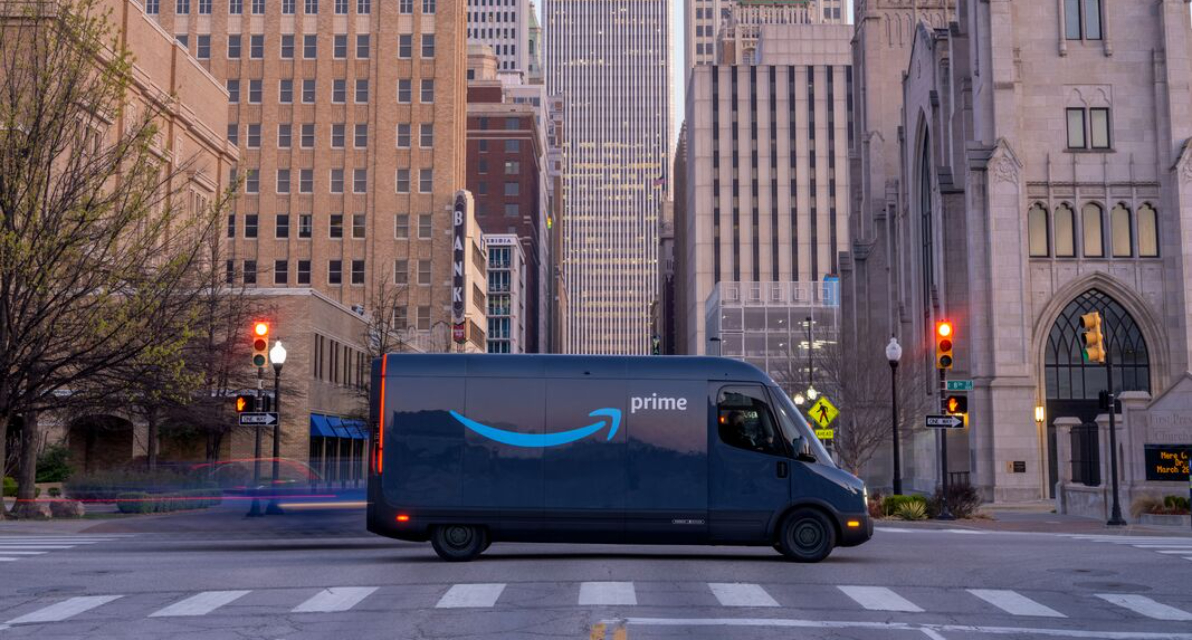
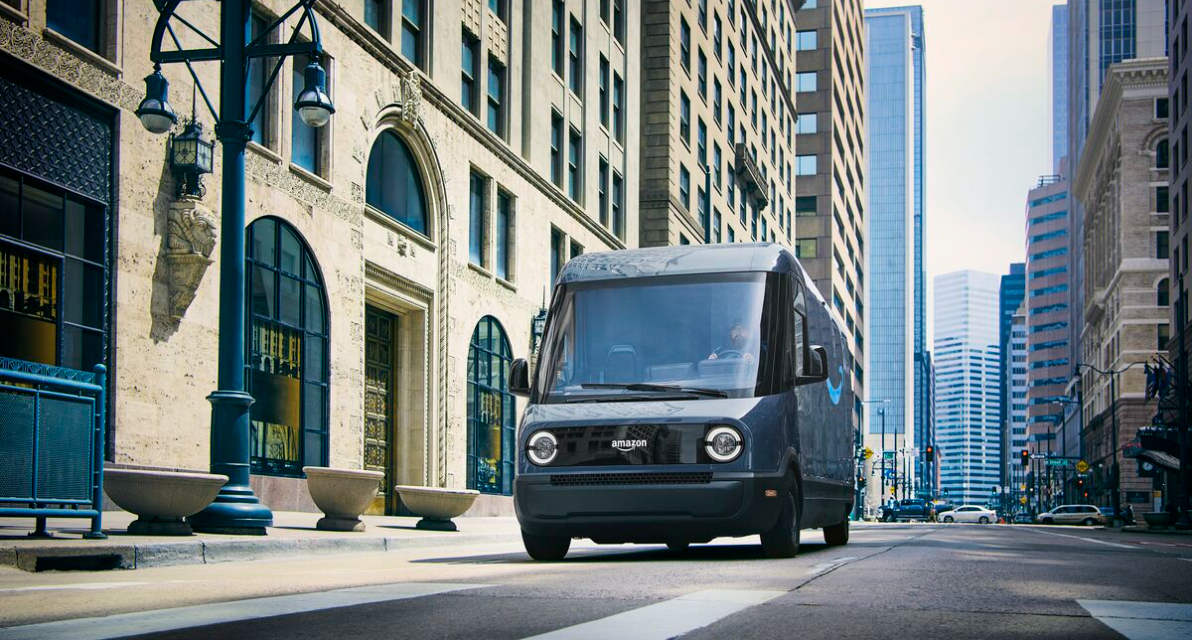
Transportation is key to curbing Amazon’s operational footprint, which is why in 2019 we set a goal to put at least 100,000 electric delivery vans on the road by 2030. As of June 2025, we had deployed more than 36,000 electric vehicles (EVs) across the U.S., EU, and India. It’s solid progress, but decarbonizing our operations requires more than replacing combustion vehicles with electric ones.

Our transportation network spans every step of the delivery journey—from global transportation between factories and ports to the moment you receive your package.

Our transportation network spans every step of the delivery journey—from global transportation between factories and ports to the moment you receive your package.

That’s where Amazon Principal Research Scientist André Snoeck comes in: Every day, he and other scientists on the Amazon Delivery team use operations research—a branch of math to help optimize complex systems—and other methods to scale Amazon's EV infrastructure and improve how packages get to your door. It supports our ongoing efforts to reduce carbon emissions through our transportation network, without compromising speed.
 

Scaling EV infrastructure  
 

Commercial EV drivers work in unpredictable environments, navigating rainstorms and road closures, so Snoeck and his team help manufacturers design vans tailored to Amazon's routes, including the right battery size for different geographies. To get those specs right, the team uses machine learning—a subfield of AI that finds patterns in data—to predict how much energy a route will use reflecting route patterns, geography, and seasonal variations in weather.
 

“Our team has spent years on one deceptively simple question: How much energy will an EV actually use on a delivery route?” Snoeck said. “Two routes of the same distance can use double the energy on different days. Getting that right is what makes electrifying a fleet this big possible.” 

Mathematical models developed by Snoeck and team help drivers determine when and where to stop and charge.

Mathematical models developed by Snoeck and team help drivers determine when and where to stop and charge.

The team also tackles big problems related to EV charging. Even though Amazon operates the largest private charging network in the U.S., the Amazon grids that service EVs could get overwhelmed if every vehicle stops to charge at the same time. To mitigate this, Snoeck and team developed a model that makes suggestions about when and where vehicles should charge based on inputs like grid capacity limits and electricity costs. This helps ensure that routes are assigned fully charged vehicles and packages arrive on time. 
 

Optimized route planning  
 

The team also uses modeling to create better routes for the Amazon vehicles that help deliver 25 million packages daily. 
 

Scientists refer to the “last mile” as the segment of the transportation network that involves bringing your package from a local distribution hub directly to your doorstep. Planning these last mile delivery routes at Amazon's scale is another staggering math problem. "For a single delivery station, we're assigning thousands of packages to hundreds of vans. The number of possible combinations is larger than the number of atoms in the universe," Snoeck said. "That's the scale of the problem our team of scientists works on every day."
 

For EVs, the challenge is even bigger: Without accounting for energy use, about 23% of vans would run out of battery mid-route. Amazon Delivery scientists helped solve that by factoring energy predictions into route planning, so every van gets a route it can finish. Since 2022, these solutions have enabled Amazon to deliver more than 3.6 billion packages via zero-exhaust-emission modes.

The Amazon Delivery teams have pioneered breakthroughs in operations research and machine learning as they seek to reduce our carbon impact, all without compromising speed.

The Amazon Delivery teams have pioneered breakthroughs in operations research and machine learning as they seek to reduce our carbon impact, all without compromising speed.

The work that the Amazon Delivery teams are doing has real results.  By the end of 2024, Amazon had reduced carbon emissions per shipped unit by approximately one-third since 2019. The teams’ efforts contributed to this achievement. And there's a broader positive impact: The teams say their modeling offers a repeatable model for any company looking to decarbonize its logistics. 
 

“We’ve spent years working to make Amazon deliveries more sustainable,” said Julian Pachon, global science director and chief scientist for Amazon Delivery. “Our team of scientists, who genuinely care about the outcome, are creating impact beyond simply building routes—we’re proving that a delivery network this large can run on clean energy. And if what we learn helps the rest of the industry, that’s a huge win for the planet.” 
 

Learn more about Amazon’s sustainable transportation strategy.  
 

Sign up for our monthly newsletter to get Amazon sustainability updates sent directly to your inbox. 

Related stories

  • A tractor drives between rows of solar panels.

    Carbon-free energy

    Amazon News

    Apr 2, 2026 10 min 🌍 Europe

    Amazon continues to be Europe’s largest corporate purchaser of carbon-free energy , opens in a new tab

  • A person holds a box while walking away from a delivery cart.

    Transportation

    Jan 14, 2026 2 min 🌎 Global

    How Amazon is going small to make a big difference

  • A cluster of buildings in front of a hillside with blue cloudy skies.

    Carbon-free energy

    KOMO News

    Feb 16, 2026 9 min 🇺🇸 United States

    Amazon expands carbon-free energy efforts with nuclear investment in Washington State , opens in a new tab

1 of 3

Article author image

Transcript

  • Human Rights & Environmental Complaints Procedure
  • Disclaimer
  • Sitemap
  • Newsletter Sign-Up , opens in a new tab
  • The Climate Pledge , opens in a new tab
  • About Amazon , opens in a new tab
  • Amazon.com , opens in a new tab
  • Investor Relations , opens in a new tab
  • Press Center , opens in a new tab
  • Privacy Notice , opens in a new tab
  • Conditions of Use , opens in a new tab
  • Sustainability News , opens in a new tab
  • Sustainability Jobs , opens in a new tab
  • Follow on LinkedIn , opens in a new tab

© 1996-2026 Amazon.com, Inc. or its affiliates

Sustainability

© 1996-2026 Amazon.com, Inc. or its affiliates