Supply chain

We seek to enable safe, equitable, fair, and sustainable supply chains across all our businesses. We build relationships with suppliers that align with our values and are committed to improving conditions for workers.

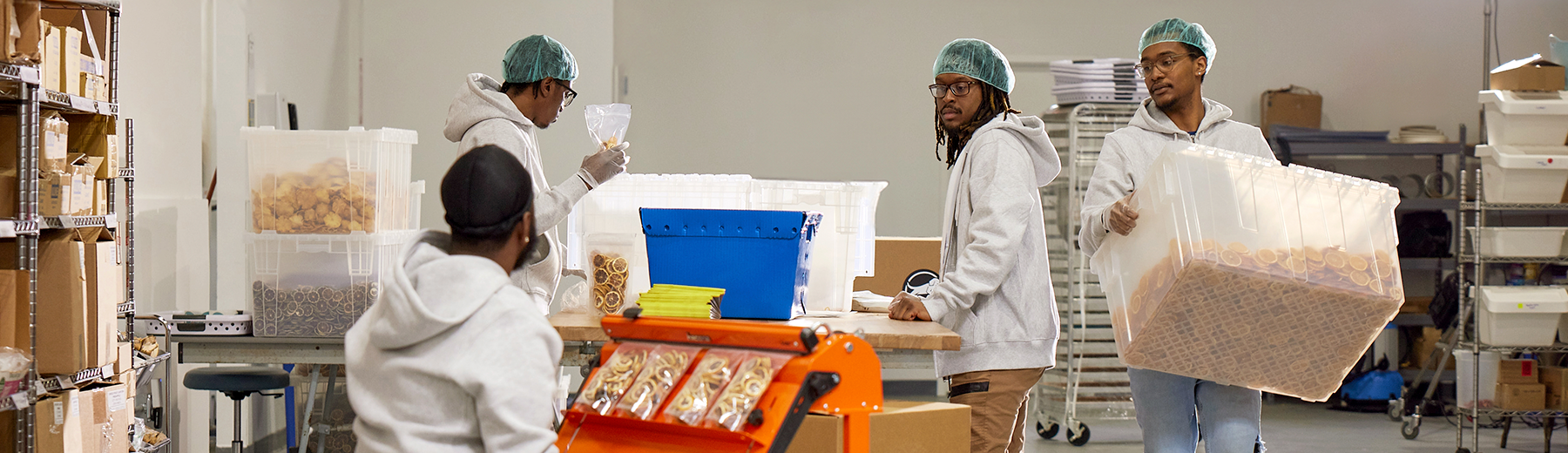
A group of people wearing hair nets sort products into bags and bins.

Progress

3K+ supplier audits conducted in 2025 covered Amazon-branded product suppliers and third-party labor, service, and not-for-resale goods providers across our logistics, warehousing, and construction supply chain

60% of suppliers attending regional human rights workshops with procurement teams and industry experts have reduced high-risk audit findings from 2023 to 2025

125K workers at supplier sites across Asia participated in safe and healthy workplace industry programs, a 42% increase from 2024 to 2025

Our approach

With a network of thousands of suppliers around the world, we embrace our ability to support safe and healthy working conditions throughout our supply chain. Our dedicated teams around the world focus on building relationships and fostering ongoing improvement. We engage directly with suppliers that support safe working conditions, fair pay, and environmental protection in their own businesses.

To build a responsible supply chain, we focus where we can have influence both directly and indirectly through our work with industry peers and other collaborators.

Safe and healthy workplaces

Everyone has a right to a safe and healthy workplace. Across the globe, we work with suppliers as well as global and regional organizations to support workers’ rights to safe and healthy workplaces.
A person wearing protective equipment moves boxes of apple cider vinegar.

Equal opportunity

Amazon supports the Resilient Futures Fund (RFF), an initiative managed by 2X Global that provides catalytic capital and targeted support to climate solutions led by, involving, or benefiting women and girls in emerging markets. In addition to financial support, Amazon serves on the fund’s Advisory Board, helping advance efforts to scale women-led climate innovation globally. Since its launch, RFF has committed more than $11 million in catalytic capital and supported 22+ grantees and 184+ organizations working on climate solutions that benefit women and girls. These efforts have helped support nearly 3,000 jobs and mobilized $10.9 million in additional climate finance. 
Learn more
A person poses in a loading dock surrounded by boxes.

Fair wages

We believe everyone has a right to be paid fairly for the work they perform, which remains a global, cross-industry issue. Wage transparency is critical to assist us in addressing wage disparities in our supply chain, and we support our suppliers in evaluating whether workers earn enough to meet their basic needs and the needs of their families. In 2025, we began exploring ways to help Amazon suppliers calculate and set their own fair minimum starting wages (using the Anker Research Institute’s methodology) in countries where they operate but no minimum wage laws exist. 
A hand reaches for a cabbage growing in the ground.

Responsible recruitment and freely chosen employment

We do not tolerate the use of child labor, involuntary or forced labor, human trafficking, or modern slavery in any form. We continually work to improve our efforts to identify, prevent, and address these risks. We work to provide individuals from vulnerable and marginalized communities access to clear, transparent information on working conditions, including pay, hiring practices, and contract terms. We work with suppliers to promote responsible recruitment practices. Amazon’s Supply Chain Standards prohibit worker-paid recruitment fees. When worker-paid recruitment fees are discovered, we guide suppliers on ethical recruitment practices, implement remediation plans to reimburse workers, and develop programs to prevent future worker-paid recruitment fees throughout the hiring process.
A delivery driver poses on a motor bike.

Environmental protection

We strive to source products and services that avoid unnecessary environmental harm. Suppliers are required to comply with applicable environmental laws and regulations. They are also encouraged to engage in efforts that support environmental sustainability, such as conducting due diligence and making progress towards minimizing adverse impacts on the environment throughout their operations and supply chains. This could include reducing energy use, greenhouse gas emissions, waste, water, pollution, and hazardous materials. 
An overhead shot of a person sorting through cotton.

Access to effective grievance mechanisms

We enable workers across our value chain to voice their concerns, whether directly to us, through supplier-managed tools, products, and systems that we support, or by connecting our suppliers to third-party grievance mechanisms. 
A group shot of people working on laptops.

Supply Chain Standards

Amazon’s Supply Chain Standards, available in 23 languages and dialects, detail our expectations for all suppliers of goods and services for Amazon, including service providers, vendors, selling partners, contractors, and subcontractors. Products sold in Amazon stores, as well as products and services provided to us, must be manufactured, produced, or provided in accordance with these standards. Suppliers are responsible for communicating these standards to their own suppliers.
Download Supply Chain Standards in all languages , opens in a new tab

[01]

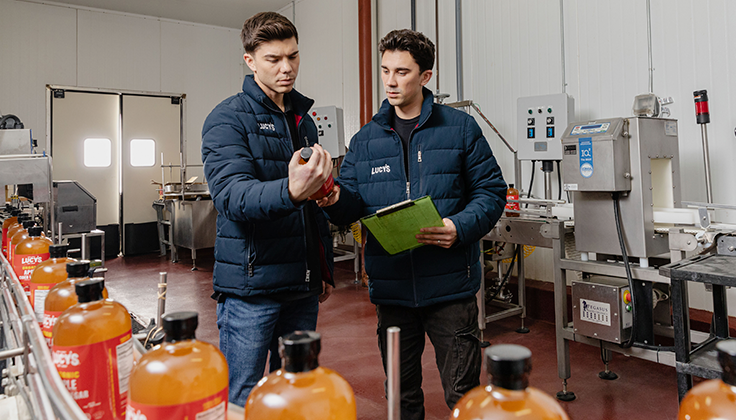
Two people examine bottled products.
  • We offer training for suppliers to stay updated on our standards, processes, and procedures and to inform their own supply chain practices. In 2025, we developed and deployed online training to 1,600 suppliers to promote awareness of the Supply Chain Standards. We also made 90 third-party online trainings on 14 human rights topics—such as anti-harassment and responsible recruitment—available to our businesses and their suppliers at scale. In 2025, we hosted 29 in-person workshops across 13 high-risk countries, engaging 650 participants from 480 suppliers. By bringing these groups together to focus on experiential learning and sharing best practices, we found that over 60% of suppliers attending these workshops had reduced high-risk findings. 

    Amazon’s Sustainability Exchange is a free, publicly available website offering Amazon-developed and other tools to help other companies seeking to make progress toward their sustainability goals, includes human rights as a focus area. Through the Amazon Sustainability Exchange, stakeholders can find information about establishing a human rights program, case studies that showcase how others are working towards implementing more sustainable practices across their operations, and resources and tools to empower businesses to take action. 
  • Selling partners are retail vendors and third-party sellers that sell or supply products and services in our stores. 
     
    We extend our Supply Chain Standards to selling partners by incorporating them into our business relationships. We evaluate allegations of selling partners’ violations of our Supply Chain Standards. 
     
    If we have reason to suspect products don’t meet our Standards, we may request evidence of due diligence from selling partners to demonstrate products were manufactured in accordance with our Standards. We reserve the right to remove products that don’t meet our Standards from our stores. 

Supplier assessment and performance

Supplier audits help us to assess supplier conformance with our Supply Chain Standards, identify issues, and require corrective action when needed. We audit suppliers in four categories: labor rights, health and safety, environment, and ethics.


Audit findings are flagged as high, medium, or low depending on severity. When high-severity issues are identified, suppliers must develop corrective action plans to address identified issues as well as long-term plans to prevent recurrence. As necessary, suppliers must also undergo follow-up audits to confirm the sufficient remediation of identified issues. For medium-severity issues, we track and confirm meaningful progress toward resolution through corrective action plans, while we monitor low-severity issues for continuous improvement through maintenance audits. 

[01]

  • In 2024, we strengthened our global human rights risk management by expanding our supplier audit program to reach more of Amazon’s global logistics network. While our audits have traditionally focused on Amazon-branded product suppliers, we recognize risks to workers exist throughout our supply chain. By broadening our scope to include third-party labor, service, and not-for-resale goods providers in our logistics, warehousing, and construction supply chain, we demonstrate our commitment to making human rights risk mitigation central to our logistics business strategy and daily decisions. Over the next several years, we plan to expand these audits to our global transportation supply chain, developing approaches tailored to different businesses and supplier categories, to enhance our assessment of third-party service providers’ compliance.


    In 2025, we leveraged data from more than 3,000 audits of suppliers of Amazon-branded products and third-party labor, service, and not-for-resale goods providers in our logistics, warehousing, and construction supply chain. To enhance the ability of our experts to identify issues and categorize audit results more quickly and accurately, we have been using AI audit processing tools. An early version of one such tool processed audit reports 79% faster than manual review processes.
Supply chain transparency

Supply chain transparency is a valuable tool to detect risks and identify opportunities for brand collaboration and action in the industry.

Our supplier list and interactive supply chain map provides details on finished product suppliers of Amazon-branded apparel, consumer electronics, food and beverage, and home goods products. Recognizing the need for further transparency beyond finished product suppliers, we have been working toward greater visibility in upstream supply chains. We share our supplier list to the  Open Supply Hub, an open supply chain mapping platform used across sectors to increase supply chain transparency and collaboration. 

We update our supply chain map annually to provide customers and external stakeholders visibility into where we source. This list was last reviewed in March 2026 and is subject to change, with partial updates provided on a periodic basis. Therefore, at any given time, it may not capture suppliers of all products currently being sold. 

Explore map on Open Supply Hub , opens in a new tab Explore map on Open Supply Hub , opens in a new tab

Supply chain grievance mechanisms

.

We enable workers across Amazon’s supply chain to voice their concerns, whether directly to us or through supplier-managed tools, products, and systems to both prevent issues and address existing ones. We require suppliers to establish effective grievance mechanisms for their workers, and we actively support them to build and strengthen these systems. We help suppliers improve their own internal processes around training, triaging cases, and overall management of grievance processes

We continue to connect supplier sites with independent third-party grievance mechanisms, including in high-risk sectors and regions. In 2025, we connected supplier sites in seven countries with third-party grievance mechanisms including Ulula, Hamary Awaz Helpline, Amader Kotha Helpline, and JP-MIRAI.

Promoting human rights

Learn more about our approach to respecting and promoting human rights.

Related downloads

Article author image

Transcript